

Objective
Using postoperative 3D CT data, we performed ROM simulation with a 3D template to examine impingement in large-head Metal-on-Metal total hip arthroplasty.
Subjects
- Cases: 20 cases, 20 joints
- Sex: 1 male, 19 female
Implants Used
- Cup: Conserve Plus Cup (head size used: 36mm–50mm)
- Stem: Profemur Z
(Wright Medical Technology, Inc)
Evaluation Items
Implant Placement Position
- Cup: anteversion angle, abduction angle
- Stem: anteversion angle, varus/valgus angle, flexion/extension angle
Implant Impingement
- Flexion angle
- Extension angle
- External rotation angle at 0° extension
- Internal rotation angle at 90° flexion
Matching of the Postoperative CT-Derived Implant with the CAD Model
-
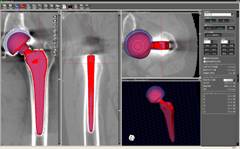
(Stem)
-
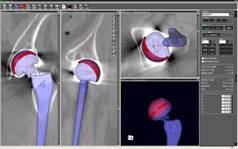
(Cup)
Results
Implant Placement Position
Cup
- Anteversion angle: 21.3°±5.8° (10.1°–33.4°)
- Abduction angle: 40.9°±5.1° (29.8°–51.2°)
Stem
- Anteversion angle: 18.0°±9.7° (12.0°–44.6°)
- Varus/valgus angle (varus = +): 0.2°±1.4° (-3.2°–2.3°)
- Flexion/extension angle (extension = +): 4.2°±2.5° (-3.5°–9.0°)
- Combined Anteversion: 43.0°±11.4° (15.6°–66.8°)
Implant Impingement
- Flexion angle: 141°±15.2° (119°–170°)
- Extension angle: 70°±12.8° (30°–90°)
- External rotation angle at 0° extension: 86°±30.2° (33°–179°)
- Internal rotation angle at 90° flexion: 62°±16.1° (34°–101°)
-
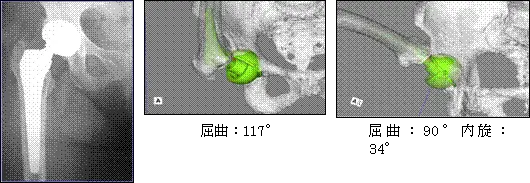
Case: 74-year-old female
Discussion
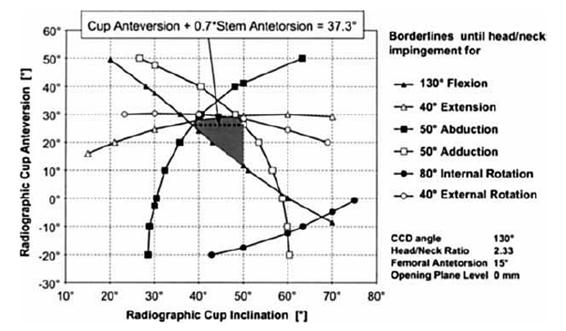
Even when using a large-head Metal-on-Metal hip implant with a large oscillation angle, proper cup and stem placement was shown to be critical for achieving a wide range of motion, and ROM simulation with ZedHip proved highly useful.
Kobe Kaisei Hospital
3-11-15 Shinoharakita-machi, Nada-ku, Kobe, Hyogo 657-0068, Japan
http://www.kaisei-navi.com